
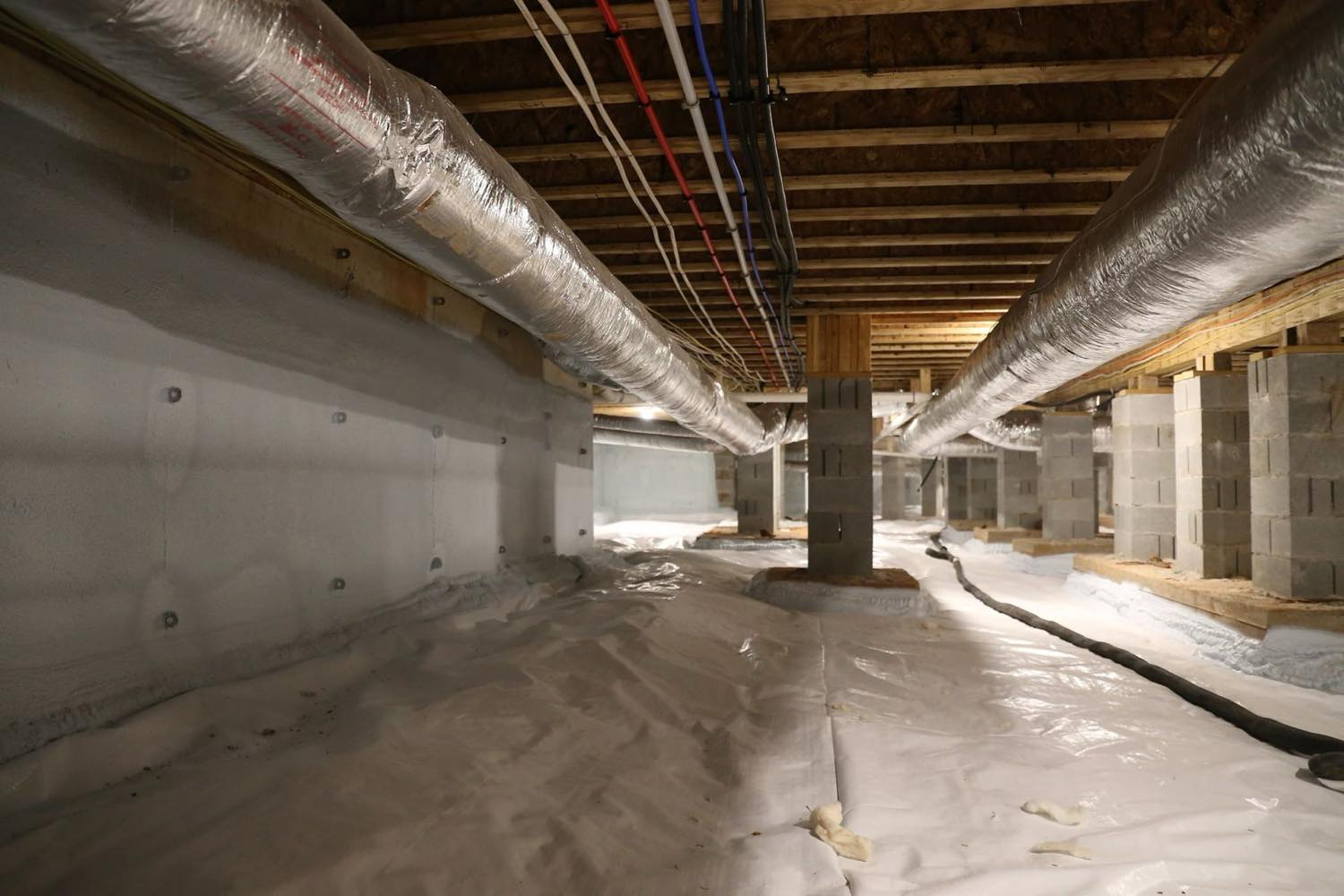
Crawl Space Encapsulation in Cross Plains, TN
Crawl space encapsulation in Cross Plains and Robertson County. Drainage and conditioning near the Middle Fork of Red River. Call (615) 492-9376.
Cross Plains sits about 49 miles northeast of our shop in Burns, at the far edge of our regular Robertson County work. We still cover it as part of our normal service area, with no travel charge for coming out.
Call (615) 492-9376 or request an estimate.
What We Find Beneath Cross Plains Houses
Cross Plains is one of the oldest settled spots in this part of Tennessee. In 1778, Revolutionary War veteran Thomas Kilgore arrived at the Middle Fork of Red River, three quarters of a mile west of the present town, and became the first European settler in what would become Robertson County. People have been building on this ground for close to two and a half centuries.
That history leaves a particular housing stock. Cross Plains has around 1,789 people and is small and largely rural, and older homes here have stood through generations of repairs, additions and patch jobs. We regularly crawl under homes where the foundation has been altered more than once: an original stone or block section, a later poured addition, a rim cut about by plumbers and electricians over the decades. Every one of those junctions leaks air and lets moisture in.
The Middle Fork of Red River and its tributaries drain this part of the county, and the low ground along them holds water after heavy rain. A crawl space near a creek bottom here can sit over damp soil from March through June. Humid air rises through the floor, the joists take on moisture, and the first the homeowner knows of it is a smell in a back bedroom or a floor that has started to give.
Vented crawl spaces make all of this worse. They were the accepted standard for decades, and most older housing here still has them. In summer, warm wet air comes through the vents, hits the cooler surfaces under the house, and condenses. In a town where many homes have passed through several owners, the crawl space is often the one part of the building nobody has properly looked at in living memory.
The Four Parts of a Proper Encapsulation
A crawl space encapsulation is a system, and each part depends on the others.
First, drainage. If water enters the space, it is collected and moved out before anything else happens. That might mean grading, a drain line or a sump. Laying a liner over a wet space just hides the water, and the mould comes back above it.
Second, the liner. We fit a heavy reinforced vapour barrier over the whole floor, wrap every pier, and run it up the foundation walls. Seams are overlapped and taped, and the top edge sealed to the wall. The liner separates the house from the damp ground permanently.
Third, sealing. Vents are closed and sealed. Gaps at the rim joist, around pipe entries and at the access door get closed with foam or gaskets. On an older home with a mixed foundation, this step stops most of the air leakage.
Fourth, conditioning. Once sealed, the space's air is kept dry, either with a small supply of conditioned air or a dedicated dehumidifier. That keeps the joists dry through a humid Tennessee summer rather than just a dry week in October.
Where It Pays Off First in Cross Plains
- Homes near the Middle Fork bottoms. Low ground along the creek stays damp well into summer. Encapsulation cuts that moisture source off at the soil.
- Houses with altered or mixed foundations. Every addition and patch is a leak point. Sealing those junctions changes how the whole house behaves.
- Older homes that have changed hands several times. If nobody has been under the house in years, the inspection alone is usually worth the visit.
- Homes with cupped hardwood or a musty smell indoors. Both trace back to crawl space moisture more often than to anything inside the living space.
- Farms and outbuildings used as living space. Converted rural buildings almost never had a proper vapour barrier fitted.
Why the Workmanship Matters More Than the Materials
The liner is only as good as its seams. A taped seam that lifts, a pier wrap left loose, or a vent boarded over rather than sealed will all let the crawl space drift back to what it was. The failure is slow, so the homeowner often does not notice until the smell returns.
We fit these systems as if we were going to maintain them ourselves, because in a small service area like ours, reputation is the whole business. Every seam rolled flat, every penetration sealed, every space conditioned to match its size. That is what makes the system still work in ten years.
Serving Cross Plains and Robertson County
Our shop is at 2715 Church St Ste B, Burns, TN 37029. Robertson County sits well within the area we work every week. Nearby towns we serve include White House, about 6 miles away, Ridgetop, about 12 miles, Coopertown, about 17 miles, and Hendersonville, about 17 miles.
See more about our crawl space encapsulation service, our spray foam insulation work, or the complete service area.
Cross Plains Insulation FAQs
Get Your Free Estimate
No pressure and no charge for the look.
Call (615) 492-9376 or request an estimate. We come out, look at the building, and give you a written price with the reasoning behind it.